
You are here
How China became the world's gold superpower
By Chow Chung-yan
South China Morning Post, Hong Kong
Thursday, October 1, 2026
https://www.scmp.com/opinion/china-opinion/article/3369170/how-china-became-worlds-gold-superpower
Perhaps no story illustrates the secret of China's industrial success better than its rise as the world's gold superpower.
China has revered the metal for millennia, yet it has never had a gold-based economy. Its own deposits were simply too scarce.
... Dispatch continues below ...
... ADVERTISEMENT ...
First Majestic Mines Silver and Gold,
Mints Its Own Silver Bars, Ingots, Coins, and Medallions,
and Sells Them Online at Low Premiums
First Majestic is a publicly traded mining company focused on silver and gold production in Mexico and the United States. The company owns and operates four producing underground mines in Mexico: the Cerro Los Gatos Silver Mine (the company holds a 70% interest in the Los Gatos Joint Venture that owns and operates the mine), the Santa Elena Silver and Gold Mine, the San Dimas Silver and Gold Mine, and the La Encantada Silver Mine, as well as a portfolio of development and exploration assets, including the Jerritt Canyon gold project in northeastern Nevada, U.S.A.
In 2025 these mines are projected to produce between 27.8 to 31.2 million silver-equivalent ounces, consisting of 13.6 to 15.3 million ounces of silver and 129,000 to 144,000 ounces of gold, with an all-in sustaining cost of $19.89 to $21.27 per payable silver-equivalent ounce.
For more information about the company, visit:
In a practice unique to First Majestic, the company is proud to manufacture exceptional silver bullion products from its 100%-owned and operated minting facility, First Mint, offering a portion of its own silver production for sale to the public. Bars, ingots, coins, and medallions are available for purchase online at the company's bullion store at low premiums.
To review First Mint’s full product range, visit:
In 1975, as China began its economic modernisation, it desperately needed gold to fund reform and build up foreign reserves. Despite its best efforts, it produced a meagre 13.8 metric tons a year. South Africa, then the undisputed king of gold, produced many times that. Canada, the United States and Australia each comfortably outproduced China as well.
Then, slowly but surely, everything changed. In 2007, China overtook South Africa to become the world's largest gold producer, and it has held that position ever since. Today it churns out 380 metric tons a year, more than South Africa, Indonesia and Mexico combined.
This was no miraculous bonanza. Beijing did set up a “gold troop” in 1979, sending the military across the country to hunt for deposits. Yet high-grade finds remained elusive until the past two years, when China announced two world-class mines: Dadonggou and Wangu. By then, the country had long since secured its crown. Its journey from a gold-poor economy with low-grade ore to the top of the league table is among the most remarkable industrial turnarounds in modern history.
It came from technological innovation, state-led industrial policy and meticulous planning.
From the 1990s, Chinese state research institutes began to master pressure oxidation (POX) for treating refractory ore. In layman's terms, it lets miners profitably process ore with vanishingly low gold content, sometimes as little as one gram per metric ton of rock. Overnight, China's vast, previously ignored low-grade fields became viable, and the country effectively gained a wealth of new reserves.
Today, about a third of China's output, or 130 metric tons, comes from low-grade fields. POX has helped China become a leading gold producer, ahead of second-placed Russia and more than double the output of the seventh-placed United States.
Curiously, China neither invented the technology nor built the biggest plants. Nor are its operating costs the lowest. The US and Canada pioneered commercial POX in the late 20th century, and some of the world's largest and most advanced facilities are still in Nevada. Russia took it to scale: its Amursk hub has the world's biggest POX autoclave vessel, and abundant cheap gas and hydropower must give Russian plants the lowest running costs anywhere.
So China wins in no single category in the POX race. It is often runner-up. Yet it dominates the game because it is the most efficient player, thanks to careful planning and coordination.
Rather than build behemoths, China runs hundreds of medium-sized mining clusters across the country. In the United States, about 75 per cent of gold comes from a single region, Nevada's Carlin Trend. China's operations are widely dispersed, so one accident or glitch will not gridlock the whole system. And unlike South Africa's mines, China's are tightly organised by the state.
Production, financing, transport and security are integrated in a closed loop. China did not build one or two mega facilities; it built an ecosystem.
The cost advantage is real, if nuanced. China's operating costs are higher than Russia's, but notably lower than those in North America or South Africa. Russian plants may be slightly cheaper to run, but their set-up and logistics costs are far higher.
Chinese POX facilities typically need 30 to 50 per cent less upfront capital than their Western rivals, according to an industry insider.
The boom had a dark side. China hit its all-time high in 2016, mining 453.5 metric tons, but local governments prized output over the environment, and pollution became serious. From 2017, Beijing enforced strict environmental and safety standards and shut down thousands of small, illegal or heavily polluting mines. Output fell by more than 25 per cent at one point before stabilising at around 380 metric tons a year. The industry that emerged is cleaner, more efficient and more competitive. Its leading operators are now expanding aggressively overseas, building plants across Africa, Central Asia, South America and even Papua New Guinea.
POX is only one pathway. China is also developing a wide range of other processing technologies. As the world's largest refiner of base metals such as copper, lead and zinc, it recovers tonnes of gold every year as a by-product of its smelters, without running a single dedicated gold mine. That amounts to 80 metric tons a year, roughly Kazakhstan's entire annual output.
It also echoes China's dominance in rare earths. A common misconception is that this rests on rich deposits. In truth, the real strength lies in its industrial ecosystem.
In the end, China leads because it has planned and organised better than anyone else. The real source of wealth is human labour combined with technology, thoughtful planning and organisation, not natural resources.
Here is the twist. Although China has been the top producer since 2007, it has also been importing gold aggressively, about 1,000 metric tons a year. Add domestic output, and China takes in some 1,400 metric tons annually. About 80 per cent is believed to go to domestic consumption, while the People's Bank of China steadily builds up its reserves.
That accumulation is just one piece of a much larger puzzle. Beijing is hoarding gold not for the metal's lustre but to support the internationalisation of the yuan. It is best understood as a dual strategy: insulating China from Western sanctions while gradually building trust in its currency as a global one.
* * *
Join GATA here:
New Orleans Investment Conference
Hilton New Orleans Riverside Hotel
Wednesday-Saturday, October 28-31, 2026
https://neworleansconference.com/gata/
* * *
Support GATA by purchasing
Stuart Englert's "Rigged"
"Rigged" is a concise explanation of government's currency market rigging policy and extensively credits GATA's work exposing it. Ten percent of sales proceeds are contributed to GATA. Buy a copy for $14.99 through Amazon:
* * *
Help keep GATA going:
GATA is a civil rights and educational organization based in the United States and tax-exempt under the U.S. Internal Revenue Code. Its e-mail dispatches are free, and you can subscribe at:
To contribute to GATA, please visit:
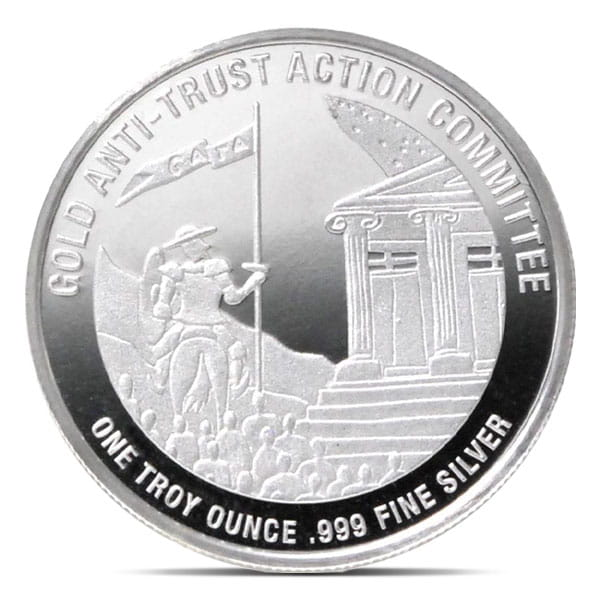
Donations of $500 or more will entitle the donor to a 1-ounce silver round commemorating GATA's work:
https://www.gata.org/sites/default/files/GATA-silver-round-front.png